
AI vs Human Writing: Why It's the Wrong Question in 2026
The 'AI or human?' argument was over by 2024 for serious content teams. The interesting question now is not whether to use AI — it's where in the process humans add irreplaceable value and where they're just slowing the work down.
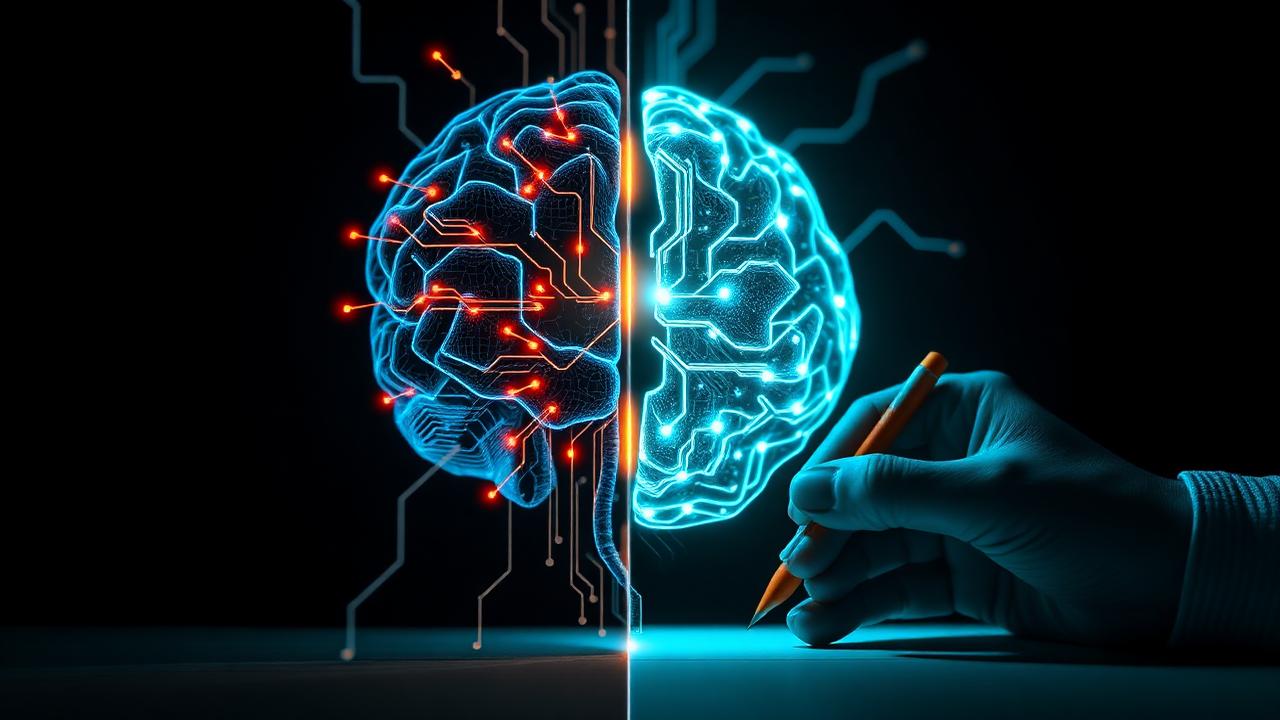
Why pure AI content fails
Generic AI content gets penalised because it deserves to. It restates what's already on page one. It has no angle, no original data, no opinion, no voice. To a model trained on the open web, it reads as exactly what it is: a slightly remixed version of every other page on the same topic.
Google's helpful content updates and the LLM ranking systems quietly agree on this. The signal both look for — 'is there something here that doesn't already exist elsewhere?' — is precisely what unsupervised AI content lacks.
Why pure human content also struggles
Humans are slow. They tire. They can't read 30 SERPs in twenty minutes. They forget to cover the obvious question because it felt obvious. They lose half a day to formatting and structural decisions a model would handle in seconds.
Teams that insist on a human for every step are out-shipped by competitors who scaled their process. They're paying premium rates for tasks AI does as well or better, then under-investing in the parts humans uniquely add.
The hybrid workflow that actually works
Across our content engagements, the pattern that produces ranking, citation-worthy content looks like this:
- AI handles SERP analysis, question expansion, competitor coverage gaps, and the first structural outline. This is research at machine speed.
- A human strategist picks the angle, the original argument, the proprietary data or case study that will make this page worth publishing. This is the irreplaceable bit.
- AI drafts to the human's outline, including the perspective and data points the human supplied. This produces a serviceable middle draft fast.
- A human editor rewrites for voice, sharpens the argument, removes filler, adds the specific examples that AI can't hallucinate convincingly, and signs the byline.
- AI handles meta tags, schema, internal link suggestions, image alt text and on-page checklist QA. Boring, important, fast.
Where humans are non-negotiable
Three things still belong fully to humans, and skipping them is what separates content that ranks from content that doesn't:
- Original perspective. A take. A position. A reason this article exists beyond 'we need an article about X'.
- Primary-source content: client work, original research, interviews, internal data. AI cannot fabricate this without becoming a liability.
- Final editorial judgement. Tone, voice, the line between confident and arrogant, the joke that lands vs the one that doesn't.
Quality control: the AI-detection trap
Don't use AI detectors as a quality gate. They produce false positives, false negatives, and they incentivise the wrong behaviour — writers padding prose with quirks to fool detectors instead of writing well.
The right quality gate is human: would a knowledgeable reader in your space learn something from this page, find it well-written, and remember the source? If yes, ship it. If no, no detector matters because the page won't earn its place anyway.
The honest summary
AI proposes. Humans dispose. The result reads like a person wrote it because a person did — they just had a much better starting point and spent their time on the parts that needed a human in the first place. That's the model. Everything else is theatre.
Frequently asked questions
Does Google penalise AI content?
Google penalises unhelpful content — it doesn't directly penalise AI assistance. Pages that demonstrate original perspective, expertise and usefulness rank regardless of how the first draft was produced. Pages that restate existing content thinly don't, regardless of who wrote them.
Can AI content rank in 2026?
Yes, when it's part of a hybrid workflow: AI-assisted research and drafting, with human angle, data, judgement and editing. Pure unsupervised AI output rarely ranks on competitive terms.
Should I disclose that AI helped write a post?
It's not legally required for most jurisdictions, but a named human author who takes responsibility for the work matters far more than disclosure boilerplate. Trust signals come from people, not disclaimers.